
By MELINDA J. OVERSTREET
for Glasgow News 1
Steps are being taken toward a bit of housekeeping regarding the closure of a “street” in Glasgow.
In reality, no street exists except in deed books and certain other records where Fifth Street is supposed to be off Grand Avenue, because it was never constructed.
Kevin Myatt, planning director for the Joint City-County Planning Commission of Barren County, explained the situation at a special-called meeting of the Glasgow Common Council Infrastructure Committee on Monday.
He said a person intends to build a house with a driveway at 124 Grand Ave., adjacent to what is apparently still publicly owned as the site of the proposed Fifth Street, which would have continued across Grand though what is now a wooded area, so the property owner is asking that it be closed.
The developers of Columbia Heights subdivision in 1931 filed a plat that “dedicated to the public certain areas as streets and public ways delineated First, Second, Third, Fourth and Fifth streets.” In 1964, developers of Stephens subdivision submitted a plat for land adjacent to Columbia Heights, with access from Grand to come via a portion of the streets named in the Columbia Heights project, “and in addition, in the part of the Stephens Subdivision, certain areas were dedicated to the public as streets and public ways delineated as First Street, Ken Bale Avenue and Third Street.”
The information about the subdivisions and related plans regarding the streets are summarized in a 1995 city ordinance; it “closed and abandoned” with regard to public ownership the portions of Second, Third and Fourth streets that were designated in the Columbia Heights subdivision plat on the southwest side of Grand, and it did the same for First and Third streets and Ken Bale Avenue designated on the Stephens subdivision plat. The ordinance also notes a 1979 civil lawsuit in Barren Circuit Court in which the court determined that First Street in Columbia Heights did not actually extend southwest from Grand Avenue so there was no access from Grand to the Stephens subdivision. Larry Jenkins, then-owner of Stephens subdivision, requested that the city file an action in court to obtain a judicial declaration that those streets were closed, the cost of which the owner would incur.
But the 1995 ordinance made no changes with regard to Fifth Street or the land designated to be used as such.
(Report continues below map graphic.)
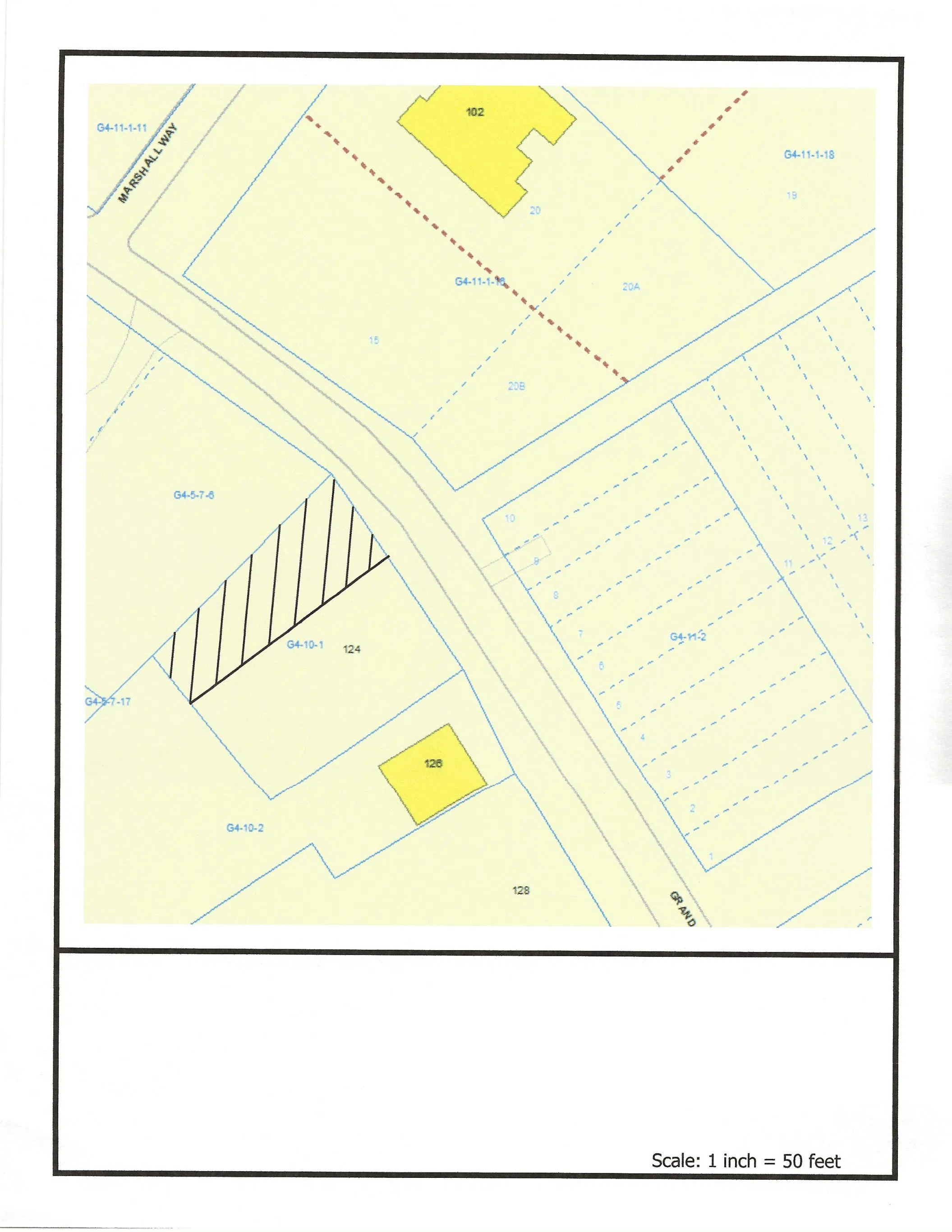
The area on this map graphic provided to members of the Glasgow Common Council Infrastructure Committee, shows Grand Avenue extending from the upper left toward the bottom right. The area with the black diagonal lines roughly depicts what was designated on a subdivision plat in 1931 as a public way for the purpose of constructing a street there, but a street was not built and the landowner at 124 Grand Avenue wishes to have at least part of the area with his property. Currently, a stormwater retention basin is established at that site.
For whatever reason, Myatt said, Fifth Street was not included in those that were closed, though it seemed they were closing all the others that had not actually been developed.
“This street was not closed out the way it was supposed to be in the ’90s,” he told the committee.
What typically happens when a street is closed is that the property is divided equally between the owners on each side, and Myatt said that if the owner on the other side of the area in question doesn’t want any of it, it would all go the owner of 124 Grand.
The potential issue here is that there is a retention basin for stormwater on the area west of Grand where Fifth Street had been proposed.
Discussion ensued regarding the various measures that could be taken to maintain the presence of a retention basin; they would include a stormwater maintenance agreement with the owner specifying the owner must maintain the basin and a stipulation in the deed that the owner cannot allow it to be blocked off — that is, unless the property owner wants to hire an engineer at his own expense to redesign a system that would not displace the stormwater volume onto others’ properties and get that plan approved and build it.
Wes Billingsley, a foreman with the Glasgow Department of Public Works, noted that the water that collects at that basin then goes underground and doesn’t surface again until the southern end of Bale Terrace. He expressed some concern that if construction of the home doesn’t properly take this into account, it could later cause it to collapse.
Myatt said the new owner doesn’t plan to put in a basement or pad, just a concrete footer, for which he’d need to go about 2 feet deep, and Billingsley said he thought that probably wouldn’t be deep enough to interfere with the underground flow.
Ultimately, with Councilman Freddie Norris absent, the three committee members present – council members Marlin Witcher, Marna Kirkpatrick and Patrick Gaunce – voted unanimously to start the process of getting the property properly “closed,” with Myatt noting before the vote that with some of the interim steps that would be required, such as a survey, it could be months before an ordinance is brought before the full council.
Comments