By GAGE WILSON
For Glasgow News 1
For nearly a century Mammoth Cave National Park has captivated locals and visitors alike. While the awe and majesty of the park is its own reward to those who visit, it doesn’t hurt that the park also generates a substantial amount of cash flow to the local economy.
In the 1980’s a group of philanthropic residents came together to assist the park in ways that the federal government could not. Recognizing how much the park meant to the area, the group coalesced into what we know as the “Friends of Mammoth Cave National Park,” a non-profit made up of eco-minded individuals.
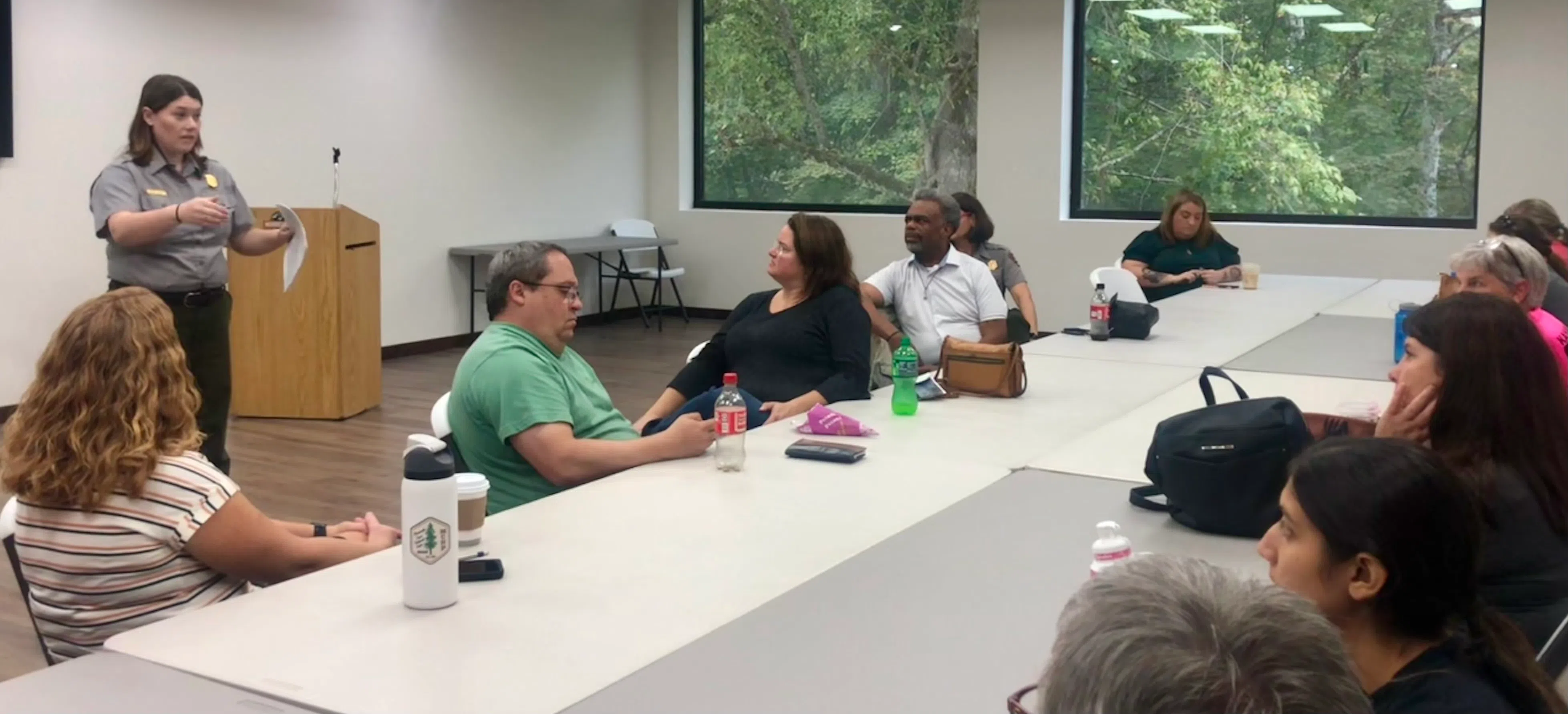
While the group has a hand in many of the cave’s activities, the most recent was the Mammoth Cave Master Class at the park’s training center on Wednesday, Sept. 18. A first of its kind class, it allowed a “behind the scenes” glimpse at the work that is put into maintaining a local resource that keeps the Barren River Area competitive on the national stage.
The group’s current executive director, Rachelle Wright, explained the work that went into putting this class together. “In the spring of 2023, Friends of Mammoth Cave was privileged to attend ‘Balancing Nature and Commerce’ at the Department of Interior’s National Conservation Training Center in West Virginia. Eight teams from around the nation were chosen for this course, made possible through The Conservation Fund. Our team consisted of leadership from Friends, Caveland Marketing Association and Mammoth Cave National Park. Like any great opportunity, you’re supposed to apply what you have learned, so Mammoth Master Class is like our course project.”
As Wright hinted at, the class was attended primarily by those involved with tourism in our area, with notable attendees being directors of tourism Jennifer McNett and Maclean Lessenberry, as well as local officials like Munfordville’s mayor Annie Swift.
“The Class is designed to be an enlightening deep dive providing an extensive behind-the-scenes look at what keeps Mammoth Cave National Park a desired destination,” Wright said. “While we applied and were chosen for this course, all three groups involved made an investment of time and resources to build stronger relationships with the gateway communities surrounding Mammoth Cave National Park. The aim is to bridge the gap in education and information on how the park and gateway communities benefit each other.”
The premier class dealt with a general understanding of the park’s operations. Superintendent Barclay Trimble opened the day’s discussions, touching on each group that goes into keeping the park going. As the day went on directors from each of the divisions offered a brief explanation of their departments.
A significant amount of Trimble’s lecture was spent on funding. According to third-party studies done on the park’s impact, Mammoth Cave benefits the area with around $90 million in local revenue.
The appropriation of funds from the U.S. Congress goes through multiple filters, and once given to the cave, the funds amount to around $7.1 million, while a substantial sum, the cost of a living wage puts the park in a precarious situation to pay its staff. Trimble pointed out that this has been an issue with most, if not all, national parks.
Trimble’s office, as with many other park superintendents, had to come up with a solution to this hurdle.
His answer lay with the 1A2G appropriations funds, which are essentially federal funds allocated specifically for national parks and other federal lands managed by agencies like the National Park Service. These funds are typically used for park operations, maintenance, resource protection, and visitor services. They support the day-to-day functioning of parks, such as staffing visitor centers, maintaining trails, preserving natural and cultural resources, and managing wildlife.
After Trimble’s hour-long lecture came to an end, participants were ushered to the park’s visitors center to learn more about the customer service that goes into trying to keep 500,000 annual visitors happy.
Class attendees were treated to a private tour of the park’s namesake, coming face to face with a more intimate look at Mammoth Cave.
Park Ranger Johnny Merideth led the tour, which encompassed the sites of the Historic Tour, as well as some added locations, such as the behind the scenes of the cave’s three bathroom areas, a spectacle promised by Molly Schroer, Management Analyst for Mammoth Cave.
The Mammoth Cave Master Class will continue over the following months, with the October class focusing on the Resource Management and Science Division of the park. This experience is expected to be offered to the public at a future date to ensure that the residents affected by the park’s impact can fully appreciate the bounty of this natural resource.
Comments