By Allyson Dix
For Glasgow News 1
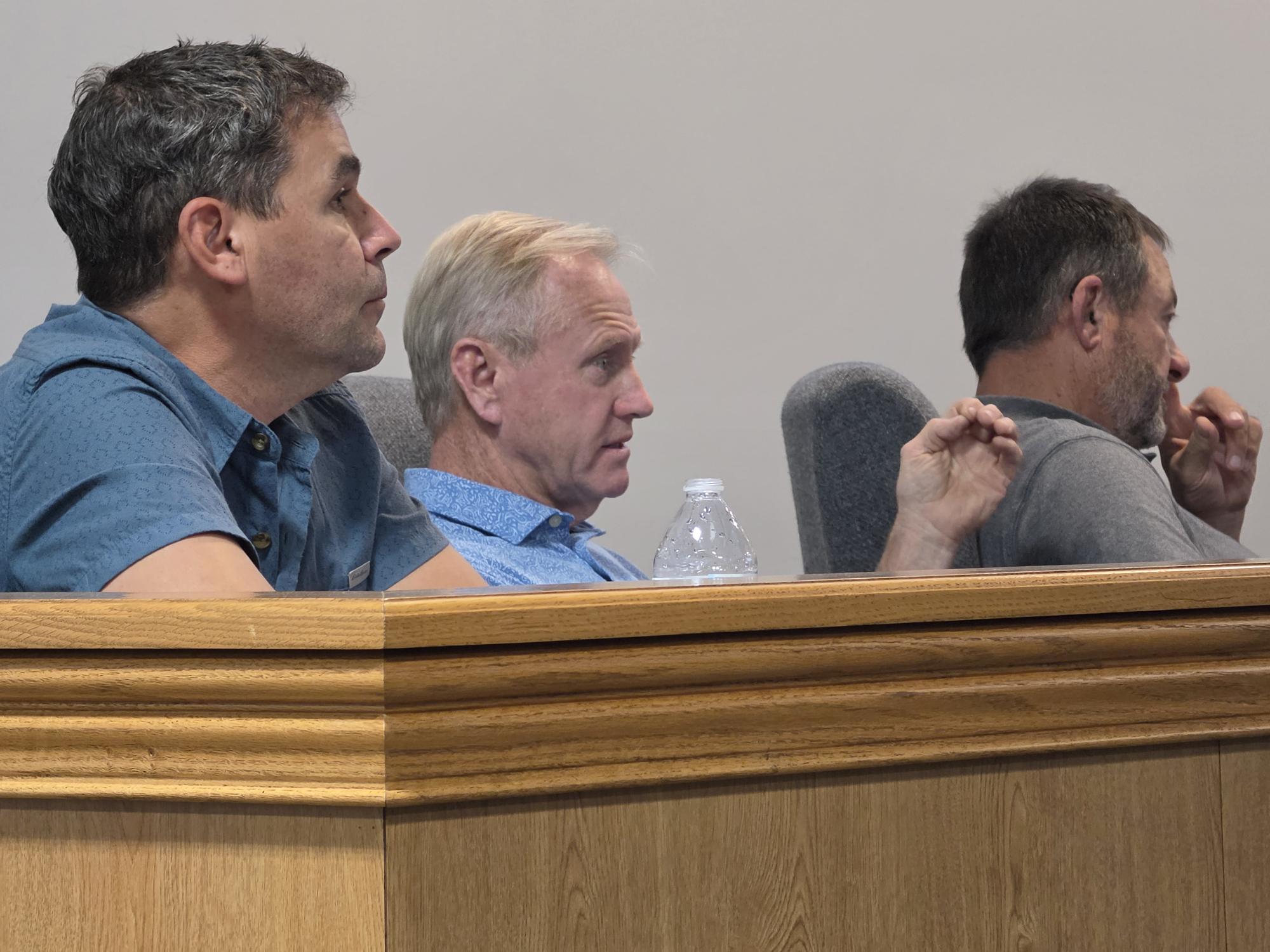
Prime farmland was a topic of discussion during Tuesday’s final Barren County Land Use Committee meeting ahead of next week’s public hearing.
The committee, which was established in late July, has helped shape the language of a draft ordinance on land use and zoning regulations. A total of eight public meetings, including four town halls over the summer, have been held to give the public opportunities to weigh in on and learn more about countywide zoning.
Reese True of Kentucky Steward, LLC, a consulting firm hired by the planning commission in July to assist in drafting the proposed zoning ordinance for high-intensity technological infrastructure, joined the meeting via Zoom along with his partners Ben True and Todd Tharpe to answer questions and provide clarifications.
Kevin Myatt, director of the Joint City-County Planning Commission, walked committee members through changes to the draft on Tuesday, starting with language related to prime farmland.
Prime farmland is land that has already been identified by the U.S. Department of Agriculture’s Natural Resources Conservation Service (NRCS).
It is defined as land with the best combination of physical and chemical characteristics for producing food, feed, forage, fiber, and oilseed crops and that is available for those uses.
Farmland designated by NRCS in Barren County falls into several categories, including prime farmland; prime farmland, if drained; and prime farmland, if drained and either protected from flooding or not frequently flooded during the growing season.
“We know exactly where prime farmland is,” Myatt said. “Now, there may be some discrepancies where people think ‘no, that’s a really good farm,’ but NRCS has it specifically listed where prime farmland is in our county.”
Myatt asked committee members whether they wanted to consider adding language restricting development on prime farmland to agricultural uses, potentially prohibiting alternative energy systems, such as solar farms.
“Should it be taken away or taken out, it has the potential to never be brought back,” Myatt cautioned.
Myatt said, for example, building a house on prime farmland is different from building a residential subdivision, which would add roads and multiple homes.
“That’ll never be destroyed and brought back to a farm; it’s lost forever,” Myatt added.
In response to a question from a committee member, Myatt said it could be argued “down the road” that a property owner wanting to sell a portion of land might be bound by conditions in place.
“It could be that you’ve overstepped your bounds on my piece of property and what I want to do with it,” Myatt said. “It’s just as a community as a whole, we’re looking out, because the planning commission is required from basically the very first page, which is in KRS 100. It says that we have to encourage responsible economic development and promote the health, safety, and welfare of the citizens.”
“So, it could be construed under that, that you’re taking away from the health and welfare of our community as a whole, because you’re removing that prime farmland,” he added.
Magistrate Tim Coomer asked whether the designation or prime farmland is based on specific soil characteristics.
Myatt said land considered prime farmland in Barren County may not be considered prime farmland in another county. The designations can also depend on how well the soil drains.
“We have about 45 different soil characteristics in Barren County, so it’s a small percentage,” Myatt said.
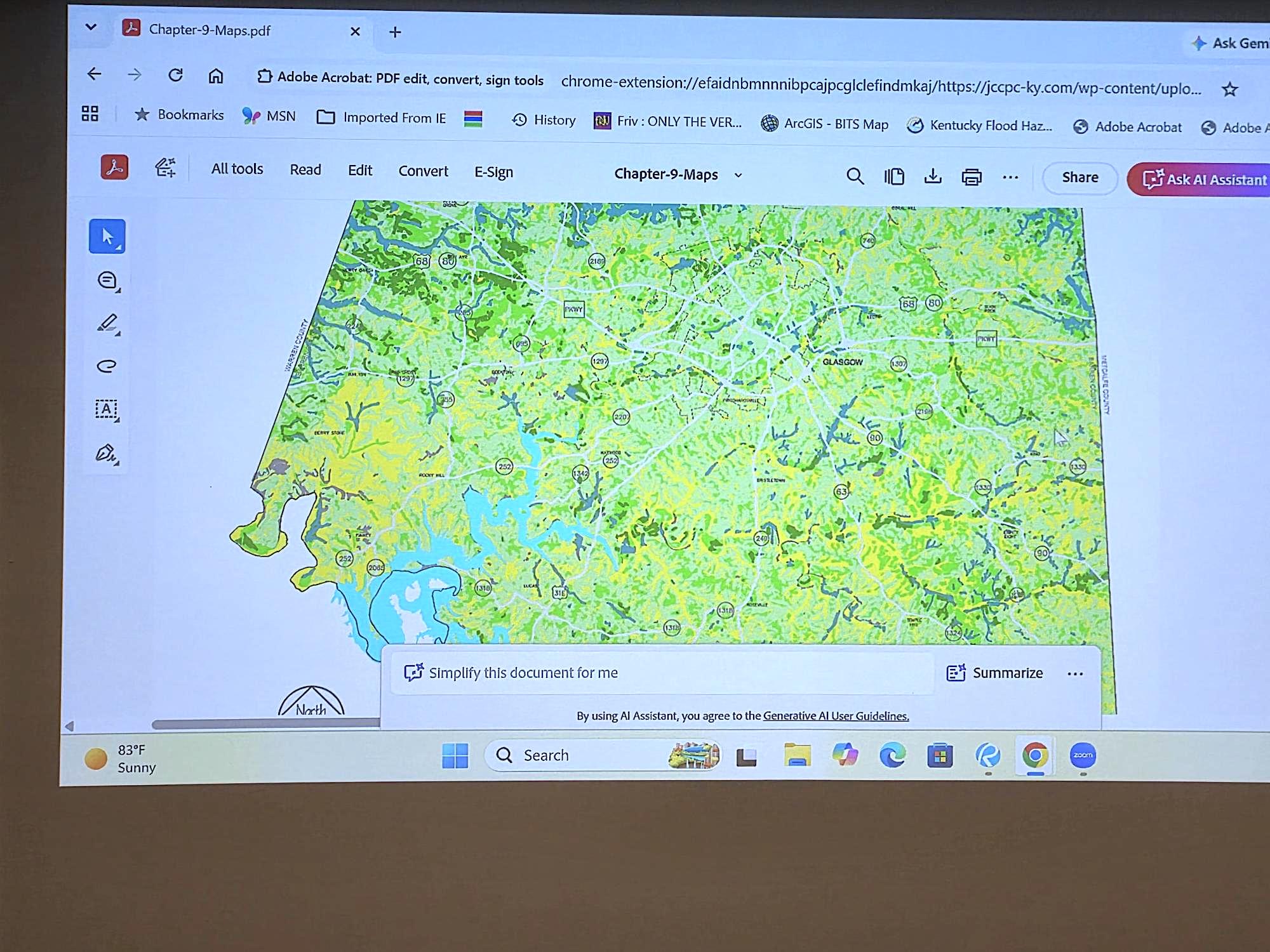
A map overlay of prime farmland in parts of Barren County that has already been established by the Natural Resources Conservation Service with the U.S. Department of Agriculture. Farmland designated by the NCRS includes six different categories, including prime farmland; prime farmland, if drained; and prime farmland, if drained and either protected from flooding or not frequently flooded during growing seasons. Allyson Dix/For Glasgow News 1
According to the current draft, designated prime farmland conditions would apply to merchant electric generating facilities, which are currently defined as a facility capable of operating at 10 megawatts or more and that sell the electricity produced in the wholesale market at rates and charges not regulated by the Kentucky Public Service Commission.
Regarding the draft ordinance that will be considered by the planning commission and later the fiscal court, Myatt said it was a defensible plan. County Attorney Mike Richardson agrees with that as well.
“It’s shown to be one of the most comprehensive plans in the whole state of Kentucky, and I believe it is one that is very defensible,” Myatt said. “If an entity wants to locate here, they’re going to have to have some skin in the game, but at the same time, they have the opportunity to locate here.”
True, who introduced himself as being a civil engineer, the owner of Kentucky Steward, LLC, and a lifelong Kentucky resident, said local governments are being asked to consider complex projects with few tools or little guidance available.
“I think it’s evident, because it is increasingly apparent, that local governments are being asked to review some of the largest and most complex infrastructure projects ever proposed in the world, in Kentucky, with very little guidance and few local tools specifically designed for that purpose,” True said.
True drafted a House Bill for legislators to consider last year with the goal of trying to change the gray areas of KRS 100, the state law that governs planning and zoning in Kentucky. Ultimately, True said, the proposed legislation never received a vote.
Article 17 of Barren County’s draft ordinance specifically applies to Digital Infrastructure Facilities with an anticipated peak electrical demand of 15 megawatts or more and Utility Infrastructure Facilities with an anticipated electrical demand of 50 megawatts or more.
Such facilities are subject to Conditional Use Permit review by the Board of Adjustment for flexible mechanism for evaluating site-specific conditions and identifying potential impacts, among other considerations, according to the most recent summarized statement on Article 17 released by the planning commission.
Article 17 of the draft ordinance allows for the planning commission to review a variety of analyses and impacts of a proposed project that a developer may be required to submit.
True said his team is committed to helping communities navigate high-intensity technological infrastructure (HITI), like large-scale data centers.
“Our team and I are ultimately left to, you know, see the smoke over the horizon and offer my handiwork as far as how to kind of best manage HITI development,” True said.
True said he hopes the current proposed HITI draft can be replicated in other communities, describing it as comprehensive, legally defensible, and stakeholder friendly.
“At the end of the day, it is a proper security protocol to make sure that developers, if they want to build in Barren County, they basically have to have the burden of proof that the proposed facility is compatible with land use requirements and plans,” True said.
True and his team will be available in person at Monday’s public hearing.
About seven residents attended Tuesday’s meeting to listen to the discussion, and asked a few questions regarding sinkholes and certain zoning classifications shown on the proposed zoning map. Committee members also asked questions for deeper understanding and provided suggestions.
State law requires for planning commissions to include a future land use map in their comprehensive plans. If adopted by the fiscal court, the zoning changes affecting more than 24,000 parcels in the county’s unincorporated areas would be considered an amendment to the 2024 Comprehensive Plan’s future land use map.
What’s Next:
The public hearing is set to begin at 7 p.m. on Monday in the Glasgow City Council chambers in the Luska J. Twyman Municipal Building, 126 E. Public Square, Glasgow.
Residents may continue to submit comments and questions before the hearing by calling 270-659-0661 or emailing barrencountyplanning@gmail.com.
The proposed zoning map is also available to the public at the Joint City-County Planning Commission office or online at https://jccpc-ky.com/announcements/barren-county-proposed-zoning-map-draft/.
The proposed zoning ordinance with the most current revisions can be found at https://jccpc-ky.com/announcements/proposed-barren-county-zoning-ordinance-draft/.
Comments